Oct 22, 2025

The Battle for Natural Conversation
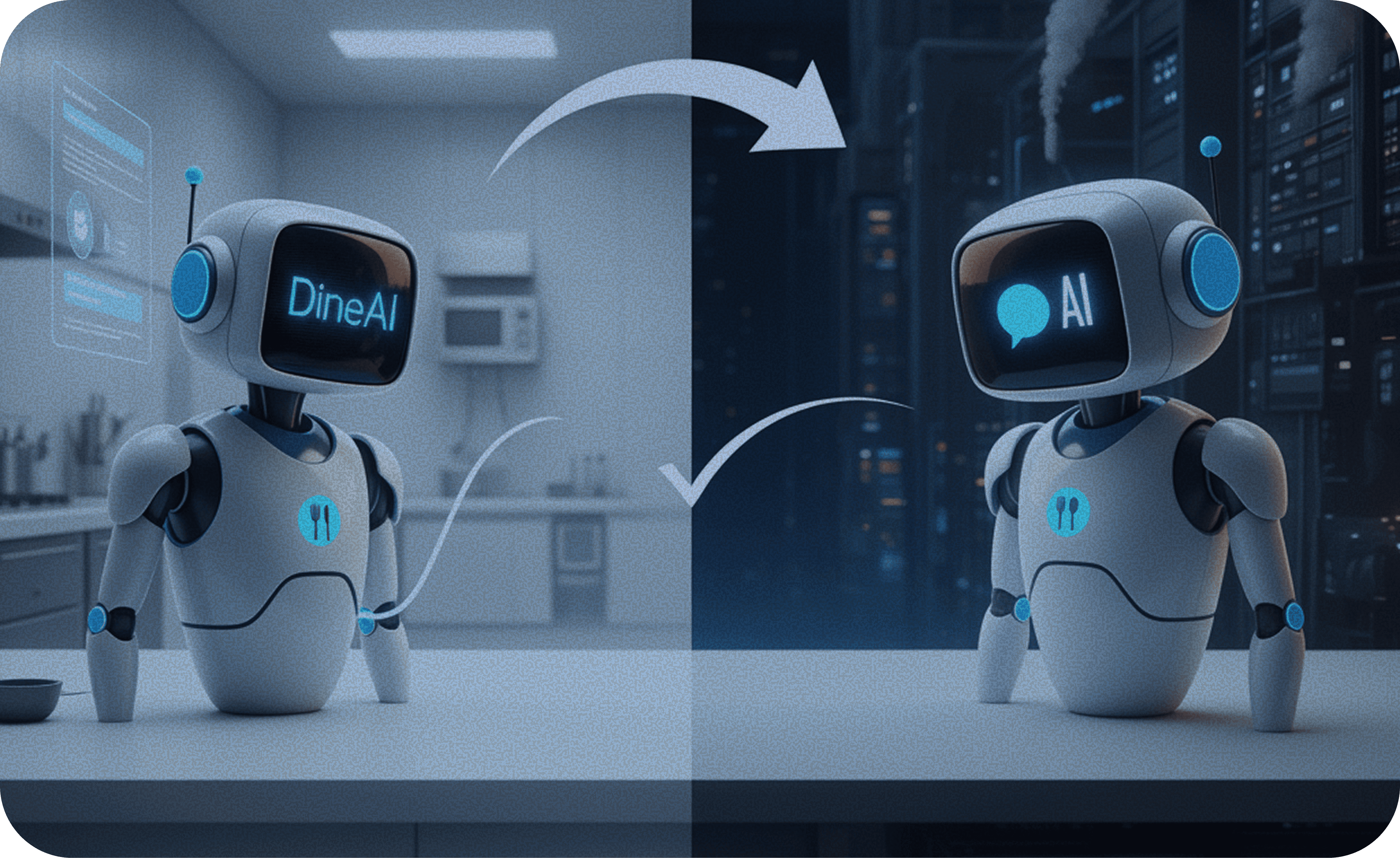
Across the hospitality sector, the term “voice AI” often conjures images of stiff, scripted interactions—conversations that sound more robotic than reassuring. PolyAI has spent years trying to change that. The company has built conversational systems for call centers, banks, and hotel chains, emphasizing realism through large language models.
But when it comes to restaurant operations, the difference between realism and relevance is enormous. DineAI focuses on one vertical—and perfects it
Broad Intelligence vs. Specialized Understanding
PolyAI’s technology is trained for a universal audience. It can handle nearly any customer service inquiry across dozens of industries. DineAI’s system, by contrast, is fine-tuned exclusively for restaurants.
That single constraint makes all the difference. Sofie, DineAI’s AI receptionist, isn’t just fluent in natural language—she’s fluent in restaurant language. She knows that “Can I grab a table at 7?” is a reservation, not a philosophical question. She recognizes when a caller says “half order” or “family-style,” and she can route complex catering calls directly to a manager without hesitation. While PolyAI’s systems often sound realistic, they rarely behave intuitively in restaurant contexts.
The Voice That Feels Familiar
Voice technology often fails not because it mishears, but because it miscommunicates tone. Sofie’s voice was designed for hospitality: calm, polite, confident, and quick.
When guests speak to Sofie, they don’t hear a generic support bot—they hear the personality of the restaurant. This is a critical design choice DineAI made early on: rather than building a “one-size-fits-all” assistant, the company built a personality layer that can be shaped around each brand.
PolyAI’s voice platform, while advanced, still leans heavily on generic phonetic models that prioritize efficiency over character. DineAI reverses that hierarchy—hospitality comes first
Insights That Matter
PolyAI’s core reporting tools provide generalized metrics—call length, intent categories, completion rates. DineAI’s dashboard goes further. It shows what drives revenue.
Managers can see exactly how many calls became reservations, what percentage of orders happened after-hours, and which menu items generate the most inquiries. Every conversation becomes part of a measurable data layer.
In short, PolyAI reports performance. DineAI reports progress.
Cost Transparency
PolyAI’s pricing operates on custom enterprise contracts, which can stretch into thousands per location per month.
DineAI’s structure is clear and predictable—$99, $399, or $799 USD per month, depending on call volume and location count. Every tier includes Sofie, POS/CRM integration, analytics, and 24/7 coverage.
The company’s philosophy is simple: hospitality shouldn’t need a procurement process.
Cost Transparency
Capability | PolyAI | DineAI |
|---|---|---|
Focus | Multi-industry conversational AI | Restaurant-only voice AI |
Deployment Time | Weeks | Hours |
Voice Personality | Generic | Brand-tailored (Sofie) |
Analytics | Call performance | Call-to-revenue insights |
POS/CRM Integration | Optional | Native |
Pricing | Enterprise | Transparent ($99–$799) |
24/7 Coverage | Add-on | Included |
A New Standard for Human AI
PolyAI helped define the modern voice AI market, but DineAI redefines its boundaries. By focusing exclusively on restaurants, DineAI turns what was once a voice interface into a hospitality experience—fast, accurate, and authentically human.
PolyAI built a framework for conversation. DineAI built a personality around service.
And in hospitality, that distinction makes all the difference.